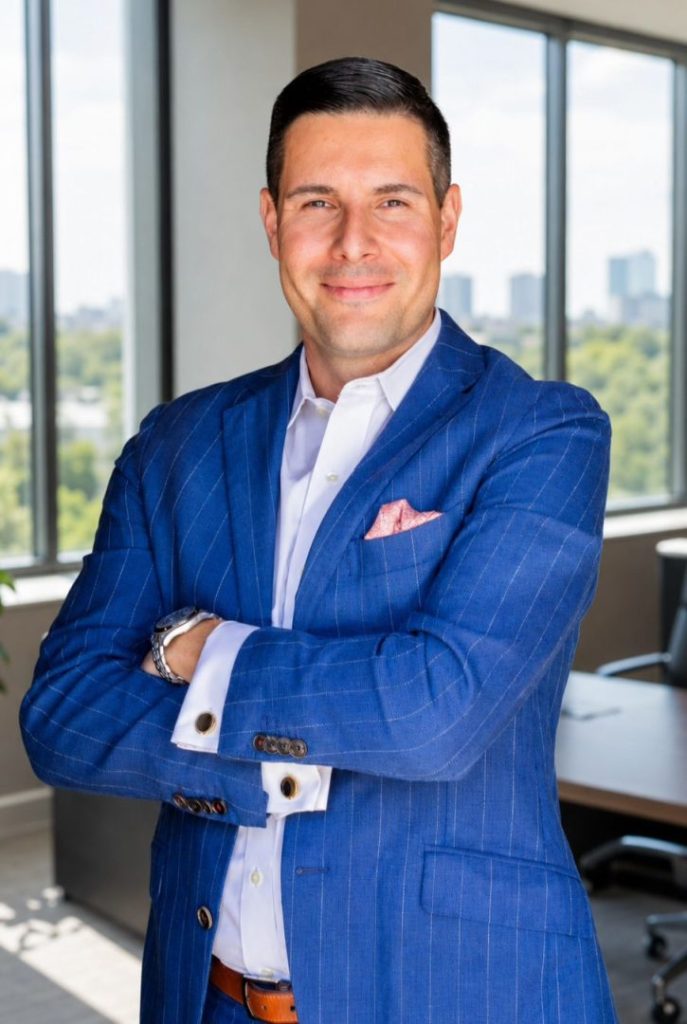

Some stories start with a moment. This one started with a Tuesday morning in September 2001.
Colton Overcash was in fourth grade when the towers fell — old enough to understand that something irreversible had happened, young enough that it shaped everything that came after. Sitting in a classroom in North Carolina, he made a quiet promise to himself: that his life would mean something. That he would serve.
It wasn’t an abstract impulse from a nine-year-old. Service was already in his DNA. His father, Reid, devoted more than 35 years of his life to EMS and his community — showing up in moments of crisis, putting others first, and doing it without recognition or fanfare. That example never left Colton. It still hasn’t.
His roots in North Carolina run deeper still. The Overcash name traces back to 1748, when Jacob Oberkirsch emigrated from Germany, crossed the Atlantic aboard the Ship Patience, and made his way south from Pennsylvania to Rowan County, North Carolina. His descendants built lives in agriculture and textiles across the Piedmont — a region the Overcash name has called home for nearly three centuries. Colton grew up in that same tradition: rooted, grounded, and shaped by a place that doesn’t make headlines but quietly determines the character of the people it produces.
He found his way to politics by accident during his undergraduate years at Western Carolina University — pursuing two degrees while discovering that the same fire that had driven him since fourth grade translated naturally into the arena of public life. The catalyst was an unlikely encounter with a then-unknown candidate named Mark Meadows, who was running for Congress for the very first time. Something clicked between them. Colton joined his burgeoning campaign — a decision that would prove to be the first of several moments in his life where the right connection at the right time changed everything.
That decision led him to Congress itself, the branch of government closest to the people. Serving in the offices of U.S. Senator Thom Tillis and U.S. Representative Virginia Foxx, he worked across nearly a third of North Carolina geographically — from Charlotte to the Virginia state line and everything west to Murphy — meeting people in communities often missed on a map and long forgotten in conversations in Raleigh and Washington. He learned what government looks like from the ground up. More importantly, he learned what it feels like to the people living inside it.
Washington came next. In 2019, Colton was appointed to serve at the U.S. Department of Homeland Security under the Trump Administration — one of the most rigorous vetting processes in American public life. It was a moment that closed two circles at once. The first was the promise made in a fourth-grade classroom eighteen years earlier. The second was quieter but no less significant: the same Mark Meadows who had given a college student his first real shot in politics had become Chief of Staff to the President of the United States. What followed would prove to be among the most consequential periods of his life.
Colton served as a senior communications and strategic affairs leader at DHS during the COVID-19 pandemic — overseeing enterprise strategic communications and coordination across one of the most complex and scrutinized federal responses in modern American history, in close coordination with the White House. That work shaped how state, local, tribal, and foreign governments understood and responded to the crisis as it unfolded in real time. He advised the Secretary of Homeland Security and other senior leaders on border security and emerging technology, and helped shape DHS’s artificial intelligence strategy at a moment when the decisions being made would echo long into the future. The fourth-grade promise had brought him here. He didn’t take that lightly.
When the private sector came calling, he joined Motorola Solutions to lead government affairs strategy across sixteen states spanning the Northeast, Mid-Atlantic, and Upper South — some of the most politically complex and consequential terrain in the country, where major urban centers, swing state capitals, and communities with vastly different priorities and definitions of good policy sit within miles of each other. It was work that felt less like a departure from public service than a continuation of it. He advocated for the policies and funding decisions that put better technology in the hands of the first responders, law enforcement officers, and emergency personnel who protect American communities every day — people like his father. He helped communities that had fallen behind catch up — driven by the conviction that failures of communication infrastructure should never cost lives that better-equipped responders could have saved. That work mattered to him in ways that went beyond the professional.
In 2023, he took a chance on himself — and on the conviction that the most important work of his career was still ahead. Vertex Strategies was born, initially a solo consultancy and now a growing advisory firm with a distinct identity, a structured service platform, and a clear mission: to give the people and organizations doing important work a partner who has been inside the environments they’re navigating, understands how decisions actually move, and knows what it takes to get something right when the stakes are real. Every chapter of Colton’s career — from a campaign office in western North Carolina to the halls of Congress, from the highest levels of the executive branch to the corporate offices of Fortune 500 companies — was preparation for this one.
Colton earned dual degrees from Western Carolina University and attended the U.S. Naval War College. He lives in Charlotte with his wife, Ashlynn — where he enjoys traveling, live music, and all the simple pleasures that make a life worth living outside the arena.