

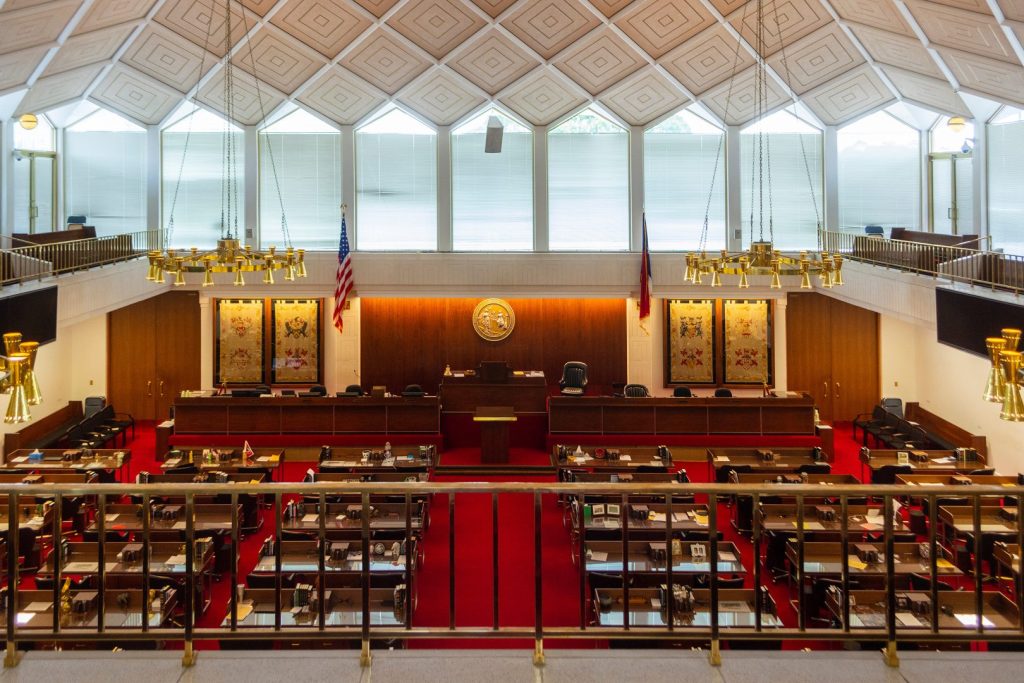
After more than a year without a state budget, House and Senate Republican leaders announced a framework on May 12. The final bill is still being drafted. The veto math is uncertain. And what’s in the framework — and what’s not — matters significantly for anyone doing business in or with North Carolina government.
North Carolina has been operating without a comprehensive two-year budget since 2023 — making it the only state in the country in that position — leaving state agencies running at 2023 spending levels, roughly 3,000 state jobs legally frozen, and a staffing crisis spreading across public safety, health care, and education. On May 12, 2026, House Speaker Destin Hall and Senate leader Phil Berger announced a framework agreement after months of closed-door negotiations.
Berger was direct about what the announcement was and was not: ‘This is a starting point. There’s still a lot that will need to be decided and discussed.’ Budget writers are still working out the specifics of what will become a conference committee report incorporated into Senate Bill 257, the 2025 Appropriations Act, before going to a final vote. Hall said he hoped to have a final budget to vote on by mid-June. The full bill text has not yet been filed.
What has been agreed to is consequential for state government, for the companies and organizations that depend on state funding, and for the long-term fiscal architecture of North Carolina. What remains unresolved — and there is more unresolved than the framework announcement suggested — deserves as much attention as the headline numbers.
Compensation Is the Headline, But the Details and Gaps Matter
The framework’s biggest commitments are on pay. Average teacher salaries will rise by 8%, with starting pay reaching $48,000. For context: according to the 2026 National Education Association report, North Carolina ranks 43rd nationally in average teacher salary at $60,000 and 38th in average starting pay at $45,000. The 8% average raise and new starting salary are genuine improvements, though they represent a partial step toward closing a gap that has widened over years of stalled budgets. Teachers with more than 16 years of experience will receive a $1,000 bonus; others receive $500. State retirees will receive a one-time 2.5% bonus.
State employees will receive a 3% raise, with larger increases in high-need areas. The most significant public safety provision in the framework — largely overlooked in early coverage — is a minimum 13% raise for law enforcement officers and prison correctional officers. Those categories have faced severe vacancy crises, and the 13% floor is the largest specific commitment in the framework for any employee group.
Governor Stein’s April 2026 proposed budget called for an 11% average teacher raise and 10% raises for public safety officers in FY 2025-26 with an additional 5% the following year. The framework’s compensation commitments are meaningful progress over the status quo; they are not the commitments Stein proposed. Stein’s initial response was measured: the pay raises would be welcome if the final budget actually includes them, but ‘the proof will be in the pudding.’ How he responds to the full package will shape the path to enactment.
Tax Policy Is the Deepest Division
The framework replaces North Carolina’s existing automatic income tax reduction trigger with a fixed schedule. The current personal income tax rate of 3.99% would drop to 3.49% from calendar years 2027 through 2029, then to 3.24% from 2030 through 2032, and to 2.99% from 2033 through 2034. Two additional revenue-triggered cuts of 0.25 percentage points each could ultimately bring the rate as low as 2.49%. The corporate income tax elimination schedule remains unchanged, with the tax being phased out by 2030.
Stein’s proposed budget took the opposite position: freeze the personal income tax at 3.99% and the corporate income tax at its current 2%, preventing what his administration projects as a structural budget shortfall. The NC Budget and Tax Center estimates the full trajectory of the income tax cuts would cost the state $2.1 billion at the 3.49% rate and ultimately over $6 billion at the lowest projected rate.
Two constitutional amendments are also being sent to November voters. One would cap the personal income tax rate at 3.5%, permanently limiting future legislative flexibility. The other would restrict how much local governments can increase property tax levies — with the specific restriction amount still to be determined by the legislature. The House has already begun moving these amendments through its chamber. Stein described the income tax cap as putting North Carolina in a ‘financial straitjacket that could wreak havoc on our public schools and public safety’ — but he cannot veto bills referring constitutional amendments to voters. A simple majority of voters would ratify either amendment into the state constitution. Western Carolina University political science professor Chris Cooper told Carolina Public Press that the income tax cap amendment would likely succeed with voters if it reaches the November ballot.
What’s Not in the Framework — and Why It Matters
Three significant issues remain unresolved or were deliberately left out of the framework announcement, and each has direct implications for specific constituencies.
Medicaid: The General Assembly passed separate legislation addressing the FY2025-26 Medicaid shortfall in near-unanimous votes last month. But the framework does not address Medicaid funding for FY2026-27, where Governor Stein estimates $728 million will be needed to fully fund the program. How that gap is handled in the final bill will affect health care providers, managed care organizations, and the counties that depend on Medicaid matching arrangements.
Children’s hospital: Funding for a children’s hospital has been in active dispute between the chambers. Hall and Berger want some allocation; Stein thought the money would be better deployed elsewhere; Berger wanted more. No decision has been announced. Companies and organizations in the health care capital development pipeline should treat this as an unresolved signal.
Hurricane Helene recovery: Helene recovery was not included in the budget framework. Hall told reporters that legislators are ‘virtually certain’ to pass a separate recovery bill during the current short session. That means the procurement and contracting activity associated with Helene recovery — infrastructure hardening, water systems, local airport accessibility, the NCDIT disaster recovery constituent portal — will be driven by a separate legislative vehicle rather than the main budget.
Funding Signals Worth Tracking
Beyond the headline numbers, several commitments signal where state capital is flowing that companies and organizations should be monitoring before the final bill is written.
Public safety and law enforcement technology: VIPER network maintenance and body cameras for law enforcement have been consistent legislative priorities. As the final bill is drafted, procurement windows for radio infrastructure, body camera platforms, and law enforcement technology are likely to open or expand in FY 2026-27. The 13% minimum raises for law enforcement may also accelerate hiring decisions that create adjacent technology procurement needs.
Water and environmental infrastructure: Stein’s proposed budget included $25 million for contaminated wells and distressed water systems, $45 million in matching funds for federal clean drinking water investment, and $4 million for PFAS testing. The legislature’s SB 257 base appropriations include funding flows to DEQ that will support continued grants through the State Water Infrastructure Authority. Companies in water treatment, infrastructure engineering, and environmental testing should be tracking SWIA’s application cycles.
Data center electricity exemption: The framework includes a rollback of the sales tax exemption for data center electricity purchases. Exemptions for construction materials, equipment, and hardware remain intact. The rollback changes project economics at the margin for developers already in the pipeline — the more significant risk remains the five active legislative bills that would repeal exemptions more broadly.
NCInnovation: The House wants to claw back all $500 million appropriated to the nonprofit supporting university research commercialization. The Senate wants $100 million to remain. This dispute was not resolved in the framework. For companies in the research commercialization and advanced manufacturing pipeline, the resolution of this dispute will directly affect available grant funding.
The Road to Passage — and the Veto Math
The framework is not a budget. It is a set of agreed principles that must be translated into hundreds of pages of appropriations, policy provisions, and technical language before either chamber votes.
The veto math is the most consequential political variable. Senate Republicans hold a veto-proof supermajority. House Republicans are one seat short. The House version of the budget earlier this session attracted 27 Democratic votes — bipartisan support is possible, but the constitutional amendments Stein has called dangerous and the pace of income tax cuts he has called fiscally irresponsible create real friction. Stein’s calculus is genuinely difficult: a veto that blocks teacher and law enforcement raises after more than a year of stalemate carries political risk, and a signature that endorses what he has publicly opposed carries its own.
Berger’s mid-June target is the most concrete public timeline on record. It is possible but optimistic. The 2023 budget took until September to reach final enactment after framework-level agreement was in place. This cycle has accelerants — November elections, the embarrassment of being the only state without a budget, and the constitutional amendment ballot deadline — but also real friction: the Medicaid FY2026-27 gap, the children’s hospital dispute, and the NCInnovation sticking point are all unresolved, and the full bill text still has to be drafted, scored, and conferenced.
A realistic planning horizon is late June to early July for a floor vote, with final enactment potentially stretching into midsummer depending on the veto path. For companies, agencies, and organizations planning against new funding levels, assume clarity will not arrive before late June at the earliest — and build contingency into procurement and program timelines accordingly.